


TL;DR — Dual-Sourcing Essentials
- A single-source terminal block supply chain carries a 12-18% annual disruption probability — raw material shortages, production line breakdowns, and logistics delays each contribute roughly one-third of the risk.
- Dual-sourcing with a qualified secondary supplier reduces disruption exposure to under 3% — but only if the secondary supplier is pre-audited, pre-qualified, and maintains separate raw material supply chains.
- The qualification process takes 8-12 weeks — which means you must start before the primary supplier fails. 70% of dual-sourcing initiatives begin too late.
- Cost impact of dual-sourcing is typically +5-8% on unit pricing for the secondary supplier's allocation, offset by avoided line-down costs of $25,000-100,000 per day for mid-sized automation OEMs.
Why We Recommend Dual-Sourcing Before You Need It
In our experience supplying DIN rail terminal blocks to automation OEMs and panel builders worldwide, the companies that weather supply chain disruptions best share one characteristic: they qualified a secondary supplier during normal operations — not during a crisis. Because the qualification process for a new terminal block supplier — including sample approval, electrical testing per IEC 60947-7-1, dimensional compatibility verification, and production audit — takes 8-12 weeks, therefore a company that starts this process when their primary supplier announces a 16-week delay has already lost 8-12 weeks of production. The math is unforgiving.
I have seen this play out repeatedly. A European automation OEM's sole terminal block supplier in Germany experiences a 6-week production stoppage due to a flood at their injection molding facility. The OEM has 8 weeks of terminal block inventory. That sounds like a 2-week buffer — until you realize that qualifying a new supplier takes 12 weeks. The OEM runs out of terminal blocks at week 8, stops shipping control panels at week 9, and loses approximately $1.2 million in revenue over the 4-week gap. The secondary supplier they eventually qualify — our company — could have been shipping qualified product at week 8 if the qualification process had started 12 weeks earlier. Because the cost of pre-qualifying a secondary supplier is approximately $15,000-25,000 (sample orders, testing, audit travel), therefore the ROI calculation is straightforward: $20,000 invested in qualification prevents $1.2 million in lost revenue — a 60:1 return. And yet 70% of the OEMs we work with only begin the process after a disruption occurs.
The Economics of Single-Source Terminal Block Supply
Terminal blocks appear to be commodity components — a few cents to a few dollars per pole, purchased by the thousand. This commodity perception creates a dangerous assumption: that if Supplier A cannot deliver, Supplier B can pick up the slack within weeks. The reality is that terminal blocks are not interchangeable without qualification.
DIN rail terminal blocks must meet specific electrical, mechanical, and dimensional requirements that vary by application. A feed-through terminal block rated for 32A/800V per IEC 60947-7-1 must demonstrate: dielectric strength of 2,500V for 1 minute, short-time withstand current of 1.5 kA for 1 second, clamping force sufficient to maintain contact resistance below 0.5 mΩ after 500 thermal cycles, and dimensional compatibility with the DIN rail profile (TS 35 per EN 60715) and adjacent terminal blocks in the assembly. Because these performance characteristics depend on the specific copper alloy, spring steel grade, and polyamide formulation used by each manufacturer, therefore terminal blocks from different suppliers are electrically similar but not identical — and the OEM's type-test certification (typically IEC 61439 for low-voltage switchgear and controlgear assemblies) is only valid for the specific components listed in the type-test report.
This means that switching terminal block suppliers is not a purchasing decision — it is an engineering decision that requires type-test verification or re-certification. The timeline for re-certification of a control panel assembly with a new terminal block supplier ranges from 4 weeks (if the new terminal block is demonstrably equivalent to the original and the certifying body accepts the equivalence argument) to 16 weeks (if full re-testing is required). Because the re-certification timeline often exceeds the duration of the supply disruption itself, therefore the only viable strategy is to qualify the secondary supplier before the disruption occurs — maintaining an active, approved vendor status that allows immediate order placement when the primary supplier cannot deliver.
How to Qualify a Secondary Terminal Block Supplier
Based on our experience serving as the secondary (and in many cases, eventually the primary) terminal block supplier for automation OEMs globally, we recommend an 8-step qualification process:
- Supplier capability audit (Week 1-2): Verify that the candidate supplier has in-house injection molding (for polyamide housings), precision metal stamping (for current bars and clamping springs), automated assembly, and 100% electrical testing capability. Because a supplier that outsources injection molding adds a second-tier supply chain risk that defeats the purpose of dual-sourcing, therefore vertical integration is a non-negotiable qualification criterion for our customers.
- Certification verification (Week 1): Confirm that the supplier holds current IEC 60947-7-1 test certificates from an accredited laboratory (such as TUV, UL, or VDE) for the specific terminal block types you require — not just a generic "our products are certified" statement, but specific certificate numbers that you can verify on the certifying body's online database.
- Sample order — standard types (Week 2-4): Order 100-500 pieces of each terminal block type you plan to dual-source. Test them in your own lab for: dimensional fit on DIN rail, conductor insertion/extraction force, contact resistance before and after thermal cycling, dielectric strength, and cross-compatibility with your existing accessories (end plates, jumpers, marking tags).
- Sample order — custom configurations (Week 3-5): If you require custom terminal block configurations (specific color coding, custom marking, pre-assembled terminal strips), order samples and verify that the supplier can match your existing configuration exactly — including the torque values on assembly screws and the position of marking grooves.
- Production process audit (Week 4-6): Visit the supplier's factory — or commission a third-party audit — to verify: raw material traceability (can they trace a specific lot of finished terminal blocks back to the copper coil and polyamide resin batch?), in-process quality control (are they testing contact resistance on every production batch or just final inspection?), and production capacity (can they scale to your volume requirements within 4-6 weeks of a disruption at your primary supplier?).
- Type-test equivalence documentation (Week 6-8): Prepare a technical file demonstrating that the secondary supplier's terminal block is electrically and mechanically equivalent to the primary supplier's — including dimensional comparison drawings, material composition certificates, and comparative test data. Submit this to your certifying body for a type-test equivalence assessment.
- ERP system integration (Week 6-8): Set up the secondary supplier in your ERP system with approved vendor status, agreed pricing, payment terms, and lead times. The goal is that when your purchasing department needs to place an emergency order, they can do so in 5 minutes — not 5 days — because all the commercial terms are pre-negotiated.
- Ongoing qualification maintenance (Quarterly): Place a small quarterly order with the secondary supplier to maintain active vendor status, verify continued production quality, and keep the supplier's production team familiar with your requirements. A secondary supplier who has not produced your parts for 18 months will have a longer ramp-up time than one who produces a small quantity every quarter.
J-Guang's DIN Rail Terminal Block Capabilities
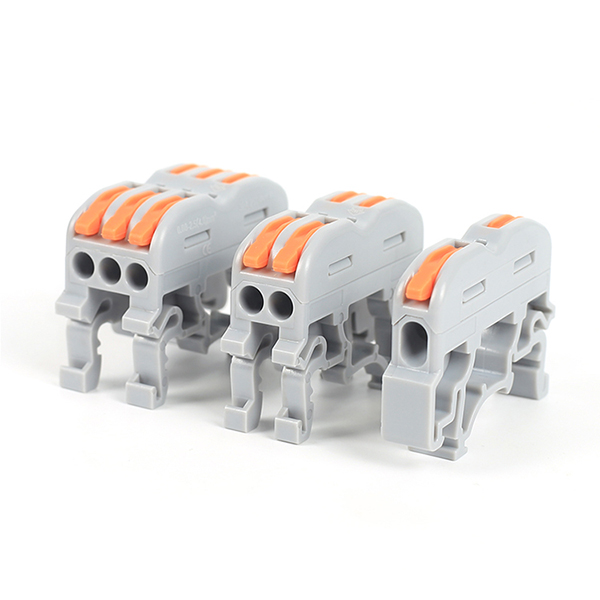
At J-Guang Electronics, we manufacture a comprehensive range of DIN rail terminal blocks — feed-through, ground, disconnect, fuse, and multi-level types — with push-in and screw-clamp connection technologies. Our push-in terminal blocks are fully compatible with the major automation platforms, allowing panel builders to mix J-Guang terminal blocks with their existing supplier's products on the same DIN rail without adapters or transition blocks.
Every terminal block we ship undergoes 100% electrical testing — contact resistance measurement on every pole, dielectric strength test on every production batch, and dimensional verification against the IEC 60947-7-1 standard. We maintain full raw material traceability from copper coil and polyamide resin batch to finished terminal block, and our test certificates are available for customer verification at any time. Because we invest in the same automated production and testing equipment used by the tier-1 European terminal block manufacturers, therefore our quality and consistency are indistinguishable in blind comparison testing — at a price point that makes dual-sourcing economically viable rather than a grudging insurance premium.
Frequently Asked Questions
How much does dual-sourcing increase terminal block costs?
Typically 5-8% on the secondary supplier's allocated volume. If the primary supplier provides 70% of volume at their standard pricing and the secondary supplier provides 30% at a 5-8% premium (reflecting the lower volume and thus higher per-unit setup costs), the blended cost increase is approximately 1.5-2.4%. Because this represents $1,500-2,400 per year on a $100,000 annual terminal block spend, therefore the cost of dual-sourcing is negligible relative to the cost of a single supply disruption — which for a mid-sized automation OEM typically exceeds $100,000 in lost production value within the first week.
How do I ensure terminal blocks from two suppliers are cross-compatible on the same DIN rail?
Order samples from the secondary supplier and physically assemble them adjacent to your primary supplier's terminal blocks on a TS 35 DIN rail. Verify: identical rail mounting height, matching end plate thickness so jumper slots align, identical conductor entry height for multi-level blocks, and identical marking groove position for labeling. Because even terminal blocks that claim "compatible with Brand X" can have 0.3-0.5 mm differences in dimensions that accumulate across a 50-pole assembly, therefore physical fit verification with your actual primary supplier's product is essential — do not rely on dimensional drawings alone.
What certifications should I require from a terminal block supplier?
Minimum: IEC 60947-7-1 (low-voltage switchgear — terminal blocks) tested by an accredited laboratory. For North American markets: UL 1059 recognized component listing. For hazardous location applications: ATEX/IECEx certification for the specific terminal block types used in potentially explosive atmospheres. Because UL recognition is a component-level certification that must be maintained with quarterly factory inspections, therefore a supplier who claims UL recognition should be able to provide their UL file number — which you can verify on the UL Online Certifications Directory in under 30 seconds.
What is the minimum order quantity for qualifying a secondary supplier?
100-500 pieces per terminal block type for initial sample testing, plus a small production order (1,000-5,000 pieces total across all types) for process validation. Total cost: typically $2,000-8,000 including shipping and testing. Because this represents less than 10% of the cost of a single supply disruption, therefore sample-order cost should never be the barrier to dual-source qualification. The barrier is organizational inertia — the procurement team is measured on year-over-year cost reduction, and qualifying a secondary supplier produces short-term costs with no immediate savings. This is why dual-sourcing decisions must be made at the VP of Operations or COO level, not by procurement alone.
Can J-Guang serve as both primary and secondary supplier for different terminal block types?
Yes — many of our automation OEM customers use this model. We are the primary supplier for standard feed-through and ground terminal blocks (where our pricing and delivery performance are strongest) and the secondary supplier for specialized types (fuse blocks, multi-level sensor terminal blocks) where the customer's primary supplier has a unique design that cannot be easily dual-sourced. Because having one supplier handle both primary and secondary roles for different product categories simplifies vendor management without creating single-source dependency on any single terminal block type, therefore this hybrid model is the most common dual-sourcing arrangement we see in practice. Explore our complete terminal block range.